
The AltaAPI and card level Protocol Engines (PEs) are unique in the industry where each 1553 channel or bank of ARINC channels is a unique logical device. In the AltaAPI Users Manual, these are referenced as a “DEVID”. Separate logical devices allow multi-application support, usually one application thread per device. This is unique and powerful as most other products on the market do not support multi applications natively in their design and force the user’s application to manage different applications.
Alta devices even have their device reset so that respective application control does not affect another device’s application thread,
even on the same card. In most cases, each device application can even have its own interrupt handler.
Each 1553 channel is a separate logical device.
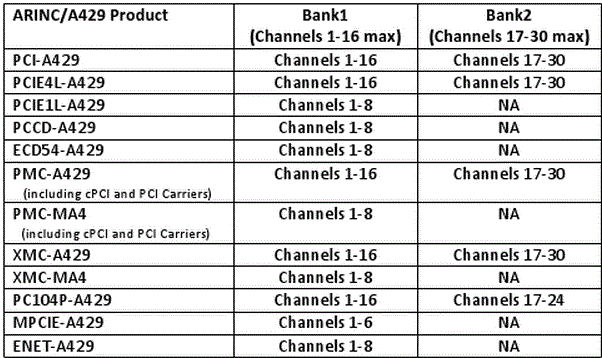
For ARINC/A429 products, channels are grouped into logical devices called a Bank. Each channel within a bank has independent controls.
An ARINC/A429 device Bank has a maximum of 16 channels and only PCI, PMC, XMC, PCI Express type cards (with larger board area) have more than16 channels,
and thus, two logical device banks. This bank number is fundamental in controlling the desired channel of the card.
The following table shows ARINC/A429 product channel assignments for each bank. Your hardware manual will provide pin-outs for the channels.
Remember, many of the first channels of each bank are shared RX and TX functions, which can be very handy for self-monitoring of TX applications.
(The pin-outs in the respective hardware manual mark these channels).
Refer to the section titled “Channels & Devices – Basic Definition Reviewed” in the AltaAPI Users
Manual located at
https://www.altadt.com/ReleaseDownloads/AltaAPI%20Users%20Manual.pdf
