
The following white paper provides a review of PCI Express and how it relates to Avionics systems, especially MIL-STD-1553 and ARINC systems.
PCI Express for Avionics
Alta Data Technologies
MIL-STD-1553 & ARINC
>PDF Download<
What is PCI Express?
PCI Express (PCIe) is a high-speed, serial, differential, point-to-point interconnect standard that replaced older shared parallel bus architectures. It provides high bandwidth and low latency for modern networking, data acquisition, and memory interfaces. In embedded systems and avionics, PCIe serves as a primary interconnect fabric (backplane), connecting host computers to interface boards such as Alta Data Technologies’ (Alta) MIL-STD-1553 and ARINC avionics network cards. It can also support direct CPU-to-memory interfaces, hard disks, and switched external interconnects (between avionics boxes).
Evolution of the PCIe Standard
In the late 1990s and early 2000s, the 32-bit Peripheral Component Interconnect (PCI) standard and its successor, 64-bit PCI Extended (PCI-X), were successful parallel bus architectures. But parallel buses are fundamentally limited by signal skew and synchronization issues at higher clock speeds, creating a hard bandwidth limit.
In 2003, a consortium of major tech companies that would become the PCI-SIG introduced PCI Express. PCIe abandoned the shared parallel bus for a high-speed serial, differential, point-to-point topology. With a switch-based architecture, each device received a dedicated, bidirectional serial link (or lane) to the host.
With this improvement, a single lane (x1) of the original PCIe 1.0 standard offered 250 MB/s of bandwidth in each direction, matching standard PCI’s practical maximums while adding scalability. Aggregating multiple lanes (x4, x8, x16) could achieve orders-of-magnitude higher data throughput. See Figure 1 for an overview.
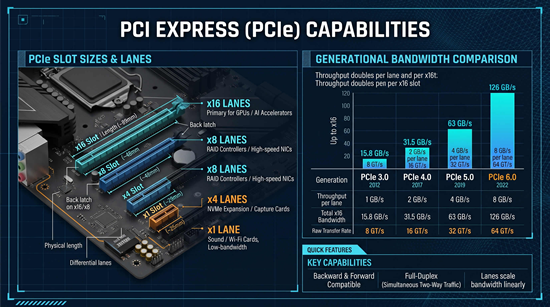
Figure 1: PCI Express Overview
PCIe – The Industry Standard for Scalability
In an industry where technology standards often become obsolete within a decade, PCIe’s longevity is exceptional. Several core architectural philosophies contribute to its resilience. One of the PCI-SIG‘s strengths is its strict adherence to backward compatibility, including the principle that software drivers that ran on old PCI systems “should” work with newer PCIe interfaces without changes. A PCIe Gen 1 card from 2004 can still plug into and function within a PCIe Gen 5 slot today, and vice versa (operating at the lowest common denominator of speed). This guarantees unprecedented investment protection for enterprise, military, and aerospace integrators that rely on long-lifecycle programs with infrequent upgrades.
From Gen 1’s 2.5 GT/s (GigaTransfers per second) to Gen 6’s 64 GT/s, PCIe has consistently stayed ahead of the curve, easily accommodating payloads like NVMe storage, high-end GPUs, and multiplexed avionics data streams.
Because PCIe is a point-to-point protocol that connects directly to the CPU’s root complex, it bypasses the overhead associated with network-based protocols like standard Ethernet. Direct memory access (DMA) capability further improves latency, a critical requirement for real-time control systems, simulation, and avionics test environments.
A key feature for avionics applications is that PCIe abstracts hardware interrupts as part of the fabric interconnect. Unlike older PCI parallel buses, which used dedicated discrete lines to signal real-time hardware interrupts to the host system, PCIe includes these signals within the fabric abstraction.
PCIe is no longer confined to desktop and server backplanes. Today, PCIe underpins a range of form factors for embedded systems, including VITA 46 (VPX) and VITA 90 (VNX+), both of which align with MOSA/SOSA initiatives, as well as add-on mezzanines such as PCIe Mini Card, M.2 (SFF), Switched Mezzanine Card (VITA 42 XMC), and Quad Module Carrier (VITA 93 QMC). A separate tutorial is provided for XMC cards and Small Form Factor (SFF).
PCIe is not tied to any particular CPU and is commonly supported across the most popular x86, ARM, and PowerPC architectures. However, the operating system often determines the level of native PCIe support. Windows and many Linux systems require a unique, vendor-provided device driver (most vendors, like Alta, provide the driver at no cost with their product). Many Linux (x86 and ARM) systems have basic PCIe memory controls built into the operating system, and many RTOS (VxWorks, Lynx, etc.) also include more sophisticated PCIe management, including hardware interrupts.
Commercial and Deployed PCIe Solutions
Avionics systems commonly use Commercial Off-The-Shelf (COTS) PCIe modules to provide high-channel-density MIL-STD-1553 and ARINC 429 interfaces. Typical PCIe card configurations include:
- Up to 10 dual-redundant MIL-STD-1553 channels
- Up to 48 ARINC 429 channels
- A combination of 5 dual-redundant MIL-STD-1553 channels and 8 ARINC 429 channels
- Low-profile cards with short or long brackets, ideal for 1U/2U/3U server racks
- Other 1553 bus derivatives like Enhanced Bit Rate (EBR) and WMUX PP194.
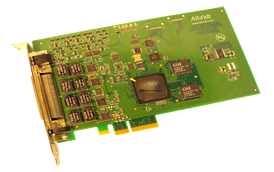
Figure 2: Example 4x Lane Alta PCIe card for MIL-STD-1553
Alta offers an extensive selection of PCIe interface cards and boards, including standard x1 and x4 lane add-in cards for server and desktop platforms; PXIe test and deployed systems; MOSA/SOSA-aligned XMC modules engineered for ruggedized military applications; and small-form-factor Mini PCI Express and M.2 products for highly embedded systems. Alta was also the first company to provide PCIe Thunderbolt™ avionics appliances, and Alta has deployed 1000s of PCIe devices across almost every major defense program.
About Alta Data Technologies
Founded in 2007, Alta is a rapidly growing company providing industry-leading COTS avionics interface products, including high-density MIL-STD-1553 and ARINC interface cards, real-time Ethernet converters, and USB/Thunderbolt™ appliances. Alta’s products are field-proven across hundreds of global military platforms, delivering technically superior solutions for PCI Express, XMC (MOSA/SOSA), VPX, PCI Express Mini Card, and M.2 form factors. For more information, visit www.altadt.com.
